


Turmeric has flavoured Indian kitchens and Ayurvedic wellness practices for generations — and today, science is catching up to what tradition already knew. At the centre of the story is curcumin, the golden compound responsible for turmeric's colour and for a fast-growing body of clinical research into joint comfort and the body's natural inflammatory response.
Here's the part that matters most if you're shopping for a turmeric supplement: not all turmeric is created equal. A pinch of everyday kitchen haldi, a cup of turmeric tea, and a concentrated curcumin capsule each deliver a very different amount of the active compound — which is exactly why VAHDAM built its turmeric range around Lakadong, a naturally higher-curcumin variety, in the format that actually suits how you want to take it.
This guide walks you through what turmeric and curcumin actually are, what the research shows about inflammation and joint comfort, why formulation and absorption make or break a turmeric product, and how to pick between powder, tea and capsules — so you can choose with confidence, not just guesswork.
What Is Turmeric? Understanding Turmeric, Curcumin & Curcuminoids
Turmeric (Curcuma longa) is a flowering plant in the ginger family. The part we use — in cooking and in wellness — is its rhizome, dried and ground into the golden powder that's a staple of Indian cuisine and Ayurvedic tradition alike.
That colour comes from curcuminoids, a family of plant compounds, of which curcumin is the star: the most abundant, the most studied, and the compound driving most of today's clinical interest. Whole turmeric brings curcumin along with a wider cast of naturally occurring compounds, including aromatic turmerones — which is one reason whole turmeric and an isolated curcumin extract can feel like genuinely different ingredients rather than two versions of the same thing.
Curcumin content isn't fixed — it varies by turmeric variety, growing region and processing. Ordinary culinary turmeric typically sits in the 2–5% curcumin range. Lakadong turmeric, grown in Meghalaya, is prized precisely because it runs meaningfully higher — up to 7–8% curcumin — which is the whole reason it anchors our turmeric range rather than a standard-grade alternative.
Does Turmeric Actually Reduce Inflammation? What the Science Says
Inflammation is your body's natural response to stress, strain and everyday wear — and it's one of the most heavily studied areas in curcumin research. Scientists track this through markers like CRP, IL-6 and TNF-α, alongside real-world outcomes like joint comfort and stiffness.
The findings are genuinely encouraging. A 2023 umbrella meta-analysis pooling data from 5,870 participants found that curcumin supplementation was linked to significant reductions in CRP, IL-6 and TNF-α (Naghsh et al., 2023). A comprehensive 2024 review spanning 54 meta-analyses of curcumin trials found the same pattern of benefit across the majority of the inflammatory markers assessed (Lee & Kim, 2024). And when it comes to joint comfort specifically — one of the most popular reasons people turn to turmeric — the evidence is even stronger: a 2024 meta-analysis of 11 pooled studies found curcumin supplementation significantly improved pain, function and stiffness scores in people managing knee osteoarthritis (Jamilian et al., 2024).
As with any wellness ingredient, results vary by study, population and formulation, and turmeric supplements are designed to support your body's inflammatory response and everyday joint comfort — not to diagnose, treat or cure any medical condition, and they're not a substitute for a doctor's care if you have a diagnosed condition. With that said, the research base here is one of the stronger, more consistent stories in the natural-wellness space, particularly around joint comfort and inflammatory markers.
Where the Research Shines Brightest
The most consistent, well-supported findings for curcumin centre on:
- Joint comfort and everyday stiffness, especially around the knees — the strongest and most replicated result in the curcumin literature (Jamilian et al., 2024)
- Key inflammatory markers such as CRP, IL-6 and TNF-α, supported across the majority of published meta-analyses (Naghsh et al., 2023; Lee & Kim, 2024)
- Exercise recovery, an emerging area with promising early human data
Why Your Turmeric Supplement's Formulation Matters
Here's the detail that separates a great turmeric supplement from an ordinary one: curcumin, on its own, is notoriously hard for your body to absorb. That's not a flaw in turmeric — it's simply a reason formulation matters more than the number on the label.
This is exactly why VAHDAM doesn't just rely on curcumin content alone. A landmark study found that pairing curcumin with piperine — the active compound in black pepper — dramatically increased how much curcumin the body actually absorbed, by as much as 2000% in that trial (Shoba et al., 1998). It's a striking number, and later research has shown the real-world boost varies by formulation — which is precisely why VAHDAM's Lakadong Turmeric Curcumin Supplement is formulated with black pepper (piperine) alongside Boswellia and ginger: a thoughtfully engineered blend built for absorption, not just concentration.
The takeaway for shoppers: a bigger curcumin number on a label doesn't automatically mean a better product. What matters is the formulation behind it — which is exactly where VAHDAM has put its focus.
Turmeric Powder vs Turmeric Tea vs Turmeric Capsules: Which Form Is Right For You?

Here's how to choose between the three:
Turmeric Powder — VAHDAM Lakadong Turmeric Powder
The most versatile way to bring higher-curcumin turmeric into your everyday life — stirred into golden milk, curries, soups or smoothies. Not all turmeric powders are created equal. VAHDAM's Lakadong Turmeric Powder is a higher-curcumin variety — not to be confused with ordinary kitchen haldi.
Why people love it: endlessly versatile, easy to fold into meals and drinks you already enjoy, a 100% whole-ingredient format, and a naturally higher-curcumin variety than ordinary turmeric.
Good to know: because it's a culinary format, the exact amount you consume will vary day to day — so if you want a precise, consistent daily dose, our capsules are the better fit.
Turmeric Tea
A comforting, ritual-friendly way to enjoy turmeric — often blended with ginger, citrus or other warming spices for a daily moment of calm.
Why people love it: easy, enjoyable, and a lovely way to build turmeric into a morning or evening routine without capsules.
Good to know: turmeric tea is naturally a lighter-touch format than a concentrated supplement — perfect for daily enjoyment, though if you're after a clinically studied dose, capsules are the more targeted choice.
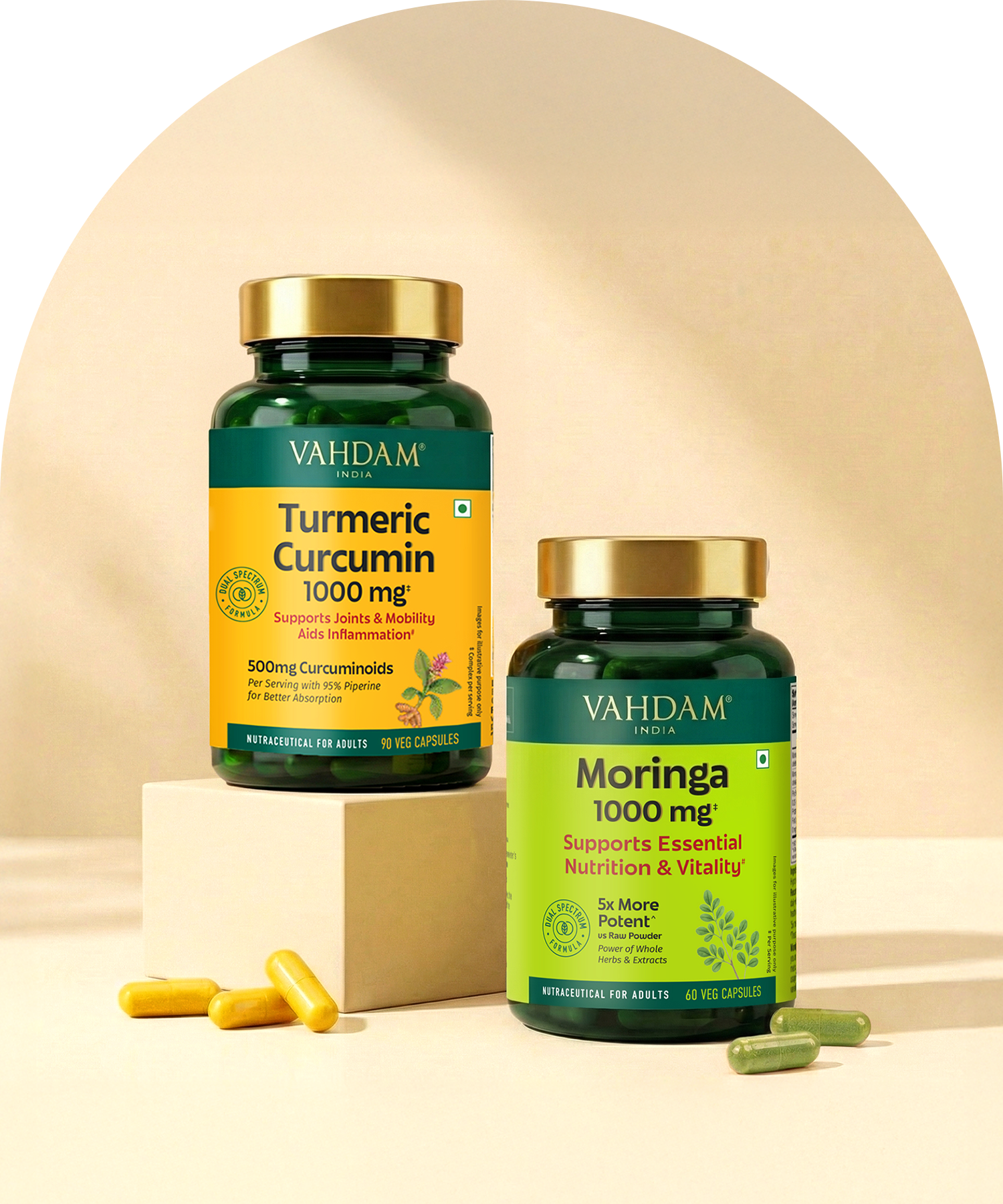
Turmeric Curcumin Capsules — VAHDAM Lakadong Turmeric Curcumin Supplement
Our most concentrated, precisely formulated option — combining turmeric extract, Lakadong turmeric, Boswellia, ginger and black pepper (piperine) into one measured daily capsule.
Why people love it: convenient, consistent, and formulated specifically with absorption in mind — the simplest way to make turmeric a reliable part of your daily routine.
Good to know: it's a more concentrated format than powder or tea, so it's worth following the recommended serving on the label and checking in with a healthcare professional if you're pregnant, nursing, or taking other medication.
Why VAHDAM's Turmeric Is Different
VAHDAM's Lakadong turmeric is grown in Meghalaya, in India's lush northeast — a region celebrated for producing turmeric with a naturally higher curcumin content, a deeper orange-red hue, and a more pronounced aroma than standard turmeric grown elsewhere.
The Bottom Line: The Best Turmeric Depends on the Form, Formulation & Your Needs
Turmeric has centuries of culinary and traditional use behind it, and curcumin — its star compound — now has a genuinely encouraging body of modern research behind it too, especially for joint comfort and everyday inflammatory support. The real key to getting the most from it is matching the form to your goal: a powder for cooking, a tea for ritual, or a capsule for a precise, absorption-optimised daily dose.
With Lakadong's naturally higher curcumin content as the foundation, and a formulation built around real absorption science, VAHDAM's turmeric range is designed to make that choice easy — whichever format fits your life, you're starting from a genuinely better turmeric.
References
Jamilian, P., Asemani, S., Zarezadeh, M., Bideshki, M. V., Behzadi, M., Radkhah, N., & Jourabchi-Ghadim, N. (2024). The efficacy of curcumin in relieving osteoarthritis: A meta-analysis of meta-analyses. Phytotherapy Research, 38(6), 2875–2891.
Lee, Y.-M., & Kim, Y. (2024). Is curcumin intake really effective for chronic inflammatory metabolic disease? A review of meta-analyses of randomized controlled trials. Nutrients, 16(11), 1728. https://doi.org/10.3390/nu16111728
Naghsh, N., Musazadeh, V., Nikpayam, O., Kavyani, Z., Moridpour, A. H., Golandam, F., Faghfouri, A. H., & Ostadrahimi, A. (2023). Profiling inflammatory biomarkers following curcumin supplementation: An umbrella meta-analysis of randomized clinical trials. Evidence-Based Complementary and Alternative Medicine, 2023, 4875636. https://doi.org/10.1155/2023/4875636
Shoba, G., Joy, D., Joseph, T., Majeed, M., Rajendran, R., & Srinivas, P. S. (1998). Influence of piperine on the pharmacokinetics of curcumin in animals and human volunteers. Planta Medica, 64(4), 353–356. https://doi.org/10.1055/s-2006-957450
White, C. M., Pasupuleti, V., Roman, Y. M., Li, Y., & Hernandez, A. V. (2019). Oral turmeric/curcumin effects on inflammatory markers in chronic inflammatory diseases: A systematic review and meta-analysis of randomized controlled trials. Pharmacological Research, 146, 104280. https://doi.org/10.1016/j.phrs.2019.104280


Leave a comment
This site is protected by hCaptcha and the hCaptcha Privacy Policy and Terms of Service apply.